200W Solar Panel Kit 7 Buying Tips for Global Buyers

Choosing a 200w solar panel kit looks simple until the technical details affect daily performance. A bright product photo cannot show voltage limits, connector quality, battery losses, or weak mounting hardware. Global buyers need a practical method for comparing complete systems, not just advertised wattage.

This guide presents seven buying tips based on common installation checks and manufacturer specifications. It examines panel efficiency, charge-controller compatibility, battery capacity, cable length, weather resistance, warranty terms, and supplier credibility. Buyers should compare Voc and Isc values with their controller’s limits. They should also confirm whether the kit suits their climate, from dusty inland heat to humid coastal conditions. Small details matter.

Real-world output is rarely equal to the label.

A 200-watt panel may produce less energy during cloudy weather, high temperatures, shading, or poor positioning. That is normal, but sellers should explain those limits clearly. Independent certifications, readable manuals, traceable test data, and responsive technical support can help separate reliable kits from incomplete bundles. Product claims still deserve careful checking. Some kits include a panel and controller but exclude batteries, brackets, or extension cables. That mistake can delay installation and increase the final cost. These seven tips will help international buyers ask better questions, compare total value, and choose a safer, more dependable solar solution for their actual energy needs.
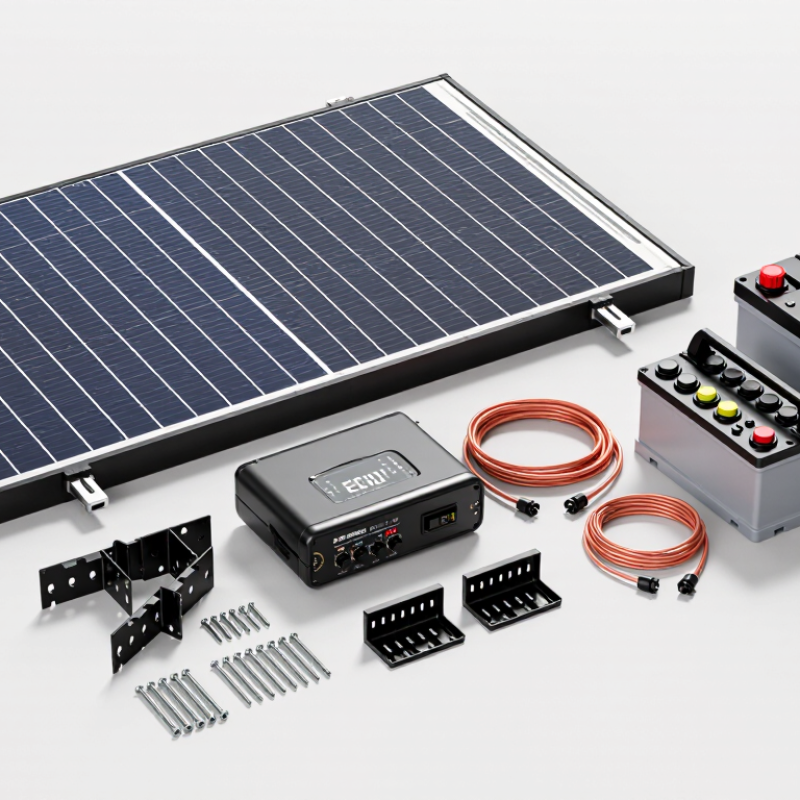
200W Solar Panel Kit 7 Buying Tips for Global Buyers

Define 200W Panel Output Under STC: 1,000 W/m² Irradiance and 25°C

200W Solar Panel Kit 7 Buying Tips for Global Buyers

A 200W solar panel does not produce 200 watts in every outdoor situation. Its rated output is measured at Standard Test Conditions, or STC. STC means 1,000 W/m² irradiance, a 25°C cell temperature, and an AM1.5 sunlight spectrum. The measurement usually represents the panel’s maximum power point. That number is conditional.

A clear noon sky may still deliver less energy after heat, haze, dust, or partial shading. Panel temperature can rise far above 25°C on a dark roof, reducing voltage and usable power. During field checks, compare the datasheet’s maximum-power voltage and current with your controller’s input range. Ask the supplier for flash-test results, output tolerance, temperature coefficients, and test conditions. These details matter more than the large “200W” label.

Cable length and connector resistance also create small losses. A practical buyer should calculate the expected daily energy, not only the nameplate wattage. For example, four effective sun hours suggest roughly 800 watt-hours before system losses. Real results may be lower. It is easy to overtrust a perfect laboratory figure. I would also inspect the glass, frame corners, junction box, and packing protection before accepting a global shipment. Small damage can become a serious performance problem later.

Estimate Daily Energy from Peak Sun Hours: 0.6–1.0 kWh in Many Regions

A 200W solar panel receives 0.2 kW of rated power under standard test conditions. With three to five peak sun hours, daily generation may reach 0.6–1.0 kWh before system losses. The Global Solar Atlas provides long-term solar irradiation data for comparing locations. Check your city, not a national average. A shaded balcony can perform very differently from a clear rooftop.

Real output is usually lower. NREL’s PVWatts documentation applies a default 14% system-loss assumption, covering wiring, inverter, and other losses. Dust, high temperatures, weak cables, and poor tilt can reduce production further. A practical estimate may therefore fall near 0.5–0.85 kWh daily. On cloudy days, it may be much less. Plan conservatively.

For buyers, compare panel power, charge-controller limits, battery voltage, cable size, and included safety protections. A 200W kit may not deliver 200W continuously. Battery charging also consumes energy. Use a plug-in meter or charge monitor during the first week. Record morning shadows and afternoon heat. IEA PVPS reports repeatedly highlight performance losses from temperature, soiling, and system conditions. My own calculation habit is simple: multiply panel wattage by local peak sun hours, then subtract realistic losses. It is imperfect, but transparent. Measure twice.

Match Voltage, MPPT Range, and Battery Capacity to 12V or 24V Systems

A 200W solar panel kit is not automatically suitable for every 12V or 24V battery system. Match the panel’s Vmp and Voc with the controller’s MPPT operating range. A “12V panel” often has a Vmp near 18V, while a 24V battery normally needs a panel with a higher operating voltage. Check cold-weather Voc, too. Voltage rises as temperatures fall.

Current sizing is clearer. A 200W array can produce about 16.7A at 12V, or 8.3A at 24V, before controller and wiring losses. Real output may drop because of heat, dust, shading, and weak sunlight. The IEA PVPS reports that global solar capacity exceeded 1.6TW by the end of 2023, but field performance still depends heavily on installation conditions. Bigger global capacity does not guarantee your panel’s daily yield.

Battery capacity must match expected energy use. A 12V, 100Ah battery stores about 1.2kWh nominally; a 24V, 100Ah battery stores about 2.4kWh. Usable energy is lower. Many lead-acid systems are conservatively designed around 50% depth of discharge, while lithium systems may allow roughly 80–90%, subject to manufacturer limits. NREL’s PVWatts guidance also shows why location-specific solar-hours matter. A 200W kit may need a 100Ah battery for light loads, but that estimate can be optimistic. Measure real nighttime consumption. Numbers expose mismatches.

Verify IEC 61215, IEC 61730, IP Ratings, and Regional Safety Compliance

A 200W solar panel kit needs more than attractive power ratings. IEA PVPS Trends 2024 reported approximately 456 GW of new photovoltaic capacity worldwide in 2023. This rapid expansion increases the importance of credible safety verification. Ask for an IEC 61215 test report covering design qualification and environmental durability. Confirm the report matches the exact panel model, not a similar product.

Check IEC 61730 for electrical, fire, and mechanical safety testing. Review the certificate issuer, report number, testing dates, and factory details. Inspect the junction box, cables, connectors, and mounting structure. Small parts can create large risks. Verify the enclosure’s IP rating, such as IP65 or IP68, and understand what protection it actually covers. IP ratings do not automatically prove resistance to every climate.

Regional compliance is equally important. A panel accepted under IEC standards may still need CE, UKCA, UL, or other local requirements. Ask whether the complete kit, including the controller and inverter, has separate approvals. IRENA’s Renewable Capacity Statistics 2024 recorded global solar capacity above 1.4 TW at the end of 2023, showing how widely equipment is deployed. However, certificates can be incomplete, outdated, or poorly translated. I would request original laboratory documents, warranty terms, traceability records, and installation guidance before payment. Also check temperature ratings for your location. Desert dust, coastal salt, and winter frost expose weaknesses that laboratory paperwork may not reveal.

200W Solar Panel Kit 7 Buying Tips for Global Buyers - Verify IEC 61215, IEC 61730, IP Ratings, and Regional Safety Compliance
Buying Tip What to Verify Technical or Regulatory Benchmark Evidence to Request Why It Matters Common Red Flag
1 Confirm the module qualification standard Check that the exact module model and construction are covered by a valid IEC 61215 qualification or type-approval report. IEC 61215 addresses design qualification and type approval for terrestrial photovoltaic modules. It evaluates environmental stresses such as thermal cycling, humidity-freeze, damp heat, mechanical load, and hail impact. Laboratory test report, certificate, model list, report number, standard edition, and the name of an accredited testing laboratory. It helps demonstrate that the module design has passed recognized durability and performance qualification tests. A document lists only a product family, a different wattage, or a similar-looking model without confirming model coverage.
2 Verify electrical safety certification Confirm that the complete module construction is covered by IEC 61730, including the relevant application class and maximum system voltage. IEC 61730 covers photovoltaic module safety requirements, including protection against electric shock, fire hazards, insulation failure, and mechanical or construction-related risks. It is separate from IEC 61215. IEC 61730-1 and IEC 61730-2 certificate or test report, safety class, maximum system voltage, module model, and certification scope. A module can pass performance qualification but still require separate safety verification before being used in a complete PV system. Marketing material says “IEC tested” without identifying whether the claim refers to IEC 61215, IEC 61730, or another test.
3 Check the actual 200W electrical specifications Compare the datasheet values for maximum power, voltage at maximum power, current at maximum power, open-circuit voltage, short-circuit current, and power tolerance. A 200W module does not have one universal voltage or current configuration. For illustration, a small nominal “24V” module may have values near 200W, Vmp around 20–21V, and Imp around 9–10A, but the actual manufacturer datasheet must be used. Model-specific datasheet showing Pmax, Vmp, Imp, Voc, Isc, temperature coefficients, dimensions, and power tolerance. Correct voltage and current matching prevents incompatibility with the charge controller, inverter, battery system, and wiring. The listing states only “200W” and “12V/24V” without electrical test conditions, tolerances, or temperature coefficients.
4 Inspect the IP rating of outdoor components Check the IP rating separately for the module junction box, connectors, controller enclosure, and any inline fuse or combiner enclosure. Under IEC 60529, the first IP digit indicates protection against solid objects and dust, while the second digit indicates protection against water. IP65 means dust-tight and protected against water jets; IP67 adds temporary immersion protection under specified test conditions. IP test report or certificate identifying the exact enclosure or component, test standard, rating, and installation conditions. Outdoor solar kits face rain, dust, condensation, and wash-down exposure. The lowest-rated component can determine the practical environmental limit of the kit. An IP rating is claimed for the panel but not for the controller, connectors, cable glands, or junction box.
5 Match regional electrical safety requirements Identify the destination country before purchase and confirm the required product marks, national standards, importer documents, and installation rules. Requirements differ by market. The European Economic Area may require applicable CE obligations; the United States and Canada commonly require recognized PV module safety certification such as UL 61730 or CSA C22.2 No. 61730; Australia and New Zealand may require local product listing and installation compliance, including AS/NZS 5033 requirements for PV arrays. Destination-specific certificate, declaration of conformity where applicable, national listing evidence, user manual, labels, and installation instructions. IEC reports alone may not satisfy national approval, grid-connection, customs, insurance, or inspection requirements. “CE certified worldwide” or “globally approved” is presented without a destination-specific declaration, listing, or applicable standard.
6 Evaluate the complete kit, not only the panel Review the charge controller, inverter, battery interface, connectors, cables, fuses, mounting hardware, grounding method, and manuals as separate components. The complete kit should have compatible voltage and current ratings, suitable conductor cross-sections, overcurrent protection, polarity identification, and an operating temperature range appropriate for the installation site. Component datasheets, wiring diagram, fuse rating, connector compatibility information, controller input limits, inverter limits, cable size, and warranty terms. A certified module does not automatically make the controller, battery wiring, connectors, or installation method safe and compliant. Mixed connector types, undersized cables, no fuse guidance, missing grounding instructions, or a controller input rating below the panel’s possible Voc.
7 Validate performance, environment, and documentation Check power tolerance, temperature coefficients, mechanical load ratings, operating temperature, degradation warranty terms, traceability, and packaging details. PV output is rated under standard test conditions, commonly 1,000W/m² irradiance, 25°C cell temperature, and an AM1.5 reference spectrum. Actual output changes with irradiance, cell temperature, orientation, shading, wiring, and dirt. Flash-test data or serial traceability, temperature coefficients, mechanical load data, warranty conditions, installation manual, packing list, and replacement procedure. A realistic yield estimate and traceable documentation are more useful than the nominal wattage alone, especially for international transport and warranty claims. “200W continuous output” is promised without test conditions, temperature information, power tolerance, serial traceability, or a written warranty.
Buyer’s verification rule: Match the certificate, test report, label, datasheet, and shipped product to the same model number and revision. Confirm the current requirements with the destination country’s competent authority or qualified installer before import and installation.

Compare Lifetime Value Using Typical PV Degradation Below 0.5% per Year

200W Solar Panel Kit: 7 Buying Tips for Global Buyers

A 200W panel should be judged by lifetime energy, not its label alone. Typical quality photovoltaic modules may degrade below 0.5% per year, but the figure needs evidence. Check the product datasheet, degradation curve, and warranty terms. Ask whether the rate is linear or includes an initial first-year drop. A 0.5% annual loss leaves about 90% output after twenty years. Small percentages become meaningful over decades.

Compare temperature coefficients before buying. Hot rooftops can reduce midday output noticeably. Inspect the frame, connectors, cable length, and mounting hardware for your climate. Confirm the controller matches the panel’s voltage and current. Check battery compatibility separately. Review independent testing, not only sales descriptions. Verify replacement parts and technical support in your destination country.

A practical test uses your local sunlight data and expected shading. Measure the roof at noon, when a nearby tree may cast a narrow shadow across one cell. That detail can reduce useful energy more than slow degradation. My own comparison mistake would be focusing on the lowest purchase price. Shipping, corrosion, damaged connectors, and an undersized controller can erase that saving. Keep performance records during the first year. Real measurements may challenge optimistic estimates, and that is useful. Reliable decisions leave room for imperfect weather, installation errors, and changing electricity prices.